Description
The 239 THL is one of the lightest carbon clincher rims on the market: 330g in pre-preg VAR carbon with a hookless tubeless bead seat, a five year manufacturing warranty, and a price point well below what comparable construction typically commands. It has been slower to sell than it deserves. The reasons for that are understandable; hookless construction is still viewed with suspicion in some quarters, and the market has drifted towards deeper, wider profiles. Neither of those things changes what this rim actually is, and for the right rider in the right conditions it is a more sensible choice than a deeper rim in ways that are practical rather than just theoretical.
On the hookless construction
Hookless rims have a straight bead seat rather than the traditional hooked edge. This is not a structural weakness. Hookless rims typically achieve a better strength-to-weight ratio than hooked equivalents because the carbon layup can be more uniform without the stress concentration that a hook introduces. The 239 THL is fully ETRTO compliant. The requirements are straightforward: your tyres must be confirmed compatible with hookless rims (most major manufacturers publish compatibility lists) and maximum tyre pressure is 72.5psi / 5 bar. Use the right tyres at the right pressures and there is nothing further to manage. The five year warranty reflects Venn’s confidence in the construction.
On the profile — and why shallow matters
Deep rims look fast. Whether they are fast depends heavily on context. A deep rim needs to be paired with a narrow tyre to realise its aerodynamic potential, and even then the advantage is most meaningful at high, sustained speeds in calm air on flat roads. The slower you ride, the larger your tyres, the rougher the terrain, the lighter you are, and the windier the conditions, the more the calculus shifts. Most riders, on most roads, in most conditions, would find the 239 THL a more enjoyable wheel to ride than the very best 50mm carbon rim, even if they weren’t quite so taken by its appearance propped up next to a latte.
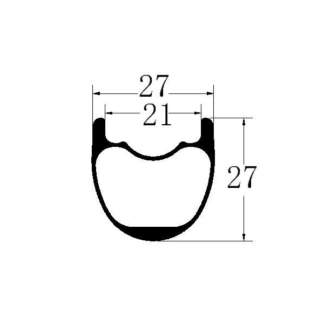
The practical case is straightforward. At 27mm deep the 239 THL is aerodynamically stable in crosswinds in a way that a deep rim is not. A deep rim presents a large lateral surface area to the wind, generating unpredictable steering forces that any rider caught by a gust on 50mm-plus carbon will recognise immediately. For smaller, lighter riders this effect is proportionally greater. For riders in hilly terrain where speeds vary and exposed ridgelines are common, this is not a trivial consideration. The 239 THL is also lighter, and shallower rims are more compliant; the reduced depth allows more vertical flex in the rim structure, which absorbs road vibration rather than transmitting it directly to the rider. Paired with a 28–32mm tyre at moderate pressures, the result is a wheel that is noticeably lively and comfortable in a way that a stiffer, deeper rim cannot replicate regardless of tyre choice.
For cyclocross the narrower 21mm internal width is an additional advantage. CX tyres develop a better profile on a narrower bed, and the shallow depth keeps weight down while reducing the crosswind sail effect that matters particularly in open, exposed CX venues.
This is not the rim for every rider or every build. But for a lighter rider tackling hilly routes, a CX racer wanting an honest weight advantage, or anyone who has quietly suspected that their deep-section wheels are more dramatic than practical, the 239 THL makes a straightforward case for itself.
On the weight
At 330g this is one of the lightest carbon clinchers available at any price. Built on BX360 hubs with Sapim Hyperlite spokes, estimated wheelset weight comes in at around 1,125g, a figure that puts it in the company of wheelsets costing two or three times as much. The BX360 is Bitex’s star-ratchet hub, designed to rival the DT Swiss 240 at a significantly lower price point.
Important — please read before ordering
This rim is hookless. Tyres must be confirmed compatible with hookless rims before use; do not assume compatibility. Maximum recommended tyre pressure is 72.5psi / 5 bar. The five year warranty covers manufacturing defects only.